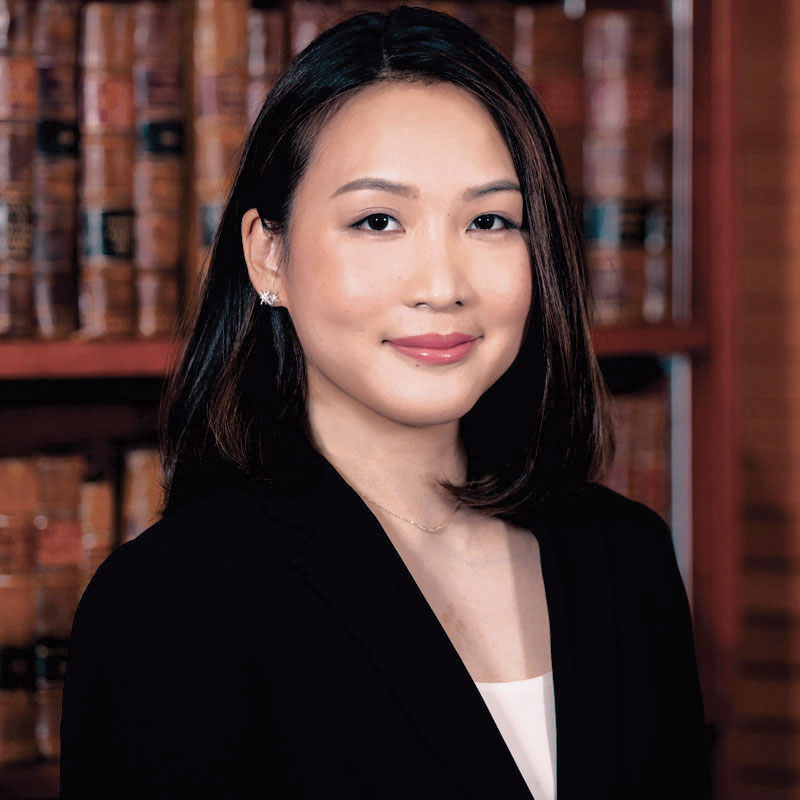

NCKP v CMY [2025] 6 HKC 559, [2025] HKCA 850 (Fiona Chong)
Fiona Chong represented the Petitioner in NCKP v CMY [2025] 6 HKC 559, [2025] HKCA 850.
The respondent wife applied for leave to appeal against the Family Court’s order requiring her to repay HK$5.6 million to the petitioner husband under s 23 of the Matrimonial Proceedings and Property Ordinance (Cap 192). The sum represented 140 months of maintenance paid by the husband after the wife’s remarriage in October 2010, which terminated the husband’s liability under a 2009 consent order. The husband claimed he was unaware of the remarriage until June 2022. The wife was at first ordered by a Master of the Family Court to make the repayment. The wife’s appeal before a judge of the Family Court was unsuccessful. The judge also refused the wife’s application for leave to appeal. The wife renewed the application before the Court of Appeal, relying on three main grounds of appeal: (1) The judge below was procedurally wrong in determining the husband’s summons for repayment based on affirmation evidence alone and without affording the wife a chance to cross-examine the deponents on the husband’s side (‘Ground 1’); (2) The judge was wrong in deciding the issues on balance of probabilities instead of a higher threshold as in summary judgment applications (‘Ground 2’); and (3) The judge misunderstood the wife’s position and ordered her to pay within a specified deadline (‘Ground 3’).
Held, unanimously, dismissing the renewed application for leave to appeal, that:
(1) The judge below was entitled to determine the repayment application summarily on affidavit evidence. Section 23 of the Matrimonial Proceedings and Property Ordinance (Cap 192) was designed for straightforward adjudication and did not require formal pleadings or oral evidence. The wife had not objected to the Master’s directions nor sought variation or appeal. Her request for cross-examination was made too late and was unjustified. The judge exercised his own discretion to reject the request and was entitled to rely on the affirmation evidence. The wife’s argument based on time limitation was also rejected; time did not begin to run until the husband discovered the mistake in June 2022. Further, there was no merit in the wife’s claim that factual disputes required oral evidence. The evidence of concealment was clear and unchallenged. LLC v LMWA [2019] 2 HKLRD 529 ; [2019] HKFLR 74 ; [2019] HKCA 347; TL v ML [2006] 1 FLR 1263; LKW v DD [2010] 6 HKC 528 ; [2011] HKFLR 106 ; (2010) 13 HKCFAR 537; Leung Wing Yi Asther v Kwok Yu Wah (2015) 18 HKCFAR 605 ; [2015] HKCU 3180; Taiping Trustees Ltd v BOSC International Co Ltd [2023] HKCFI 1189 ; [2023] HKCU 1999, X v Dr Hung Cheung Tsui & Anor [2017] HKCU 1289, (HCPI 67/2014, Chow J, 23 May 2017, unreported), Yong Li Investments Ltd v Lee Sing Leung Robin [2018] HKCFI 1711 ; [2018] HKCU 2733, Wong Kar Gee Mimi v Severn Villa Ltd [2012] 1 HKLRD 887 ; [2012] HKCU 114 and Baker v Courage & Co [1910] 1 KB 56 considered (paras 37–81).
(2) The judge below did not apply the wrong standard of proof. The applicable standard was the civil standard of balance of probabilities. The claim was not made under O 14 of the Rules of the High Court (Cap 4) and no alternative threshold applied. The judge had correctly applied the standard in assessing whether the husband had mistakenly continued payments after the wife’s remarriage (paras 83–85).
(3) There was no error in the judge’s order that repayment be made ‘forthwith.’ The term did not affect enforceability and was in compliance with O 42 r 2(2) of the Rules of the District Court (Cap 336H). The wife had ample time since the Master’s order to arrange repayment and had not proposed any reasonable instalment plan. Taiping Trustees Ltd v BOSC International Co Ltd (above) considered (paras 86–90).
[The above is excerpted from the headnote to the report in HKC.]